
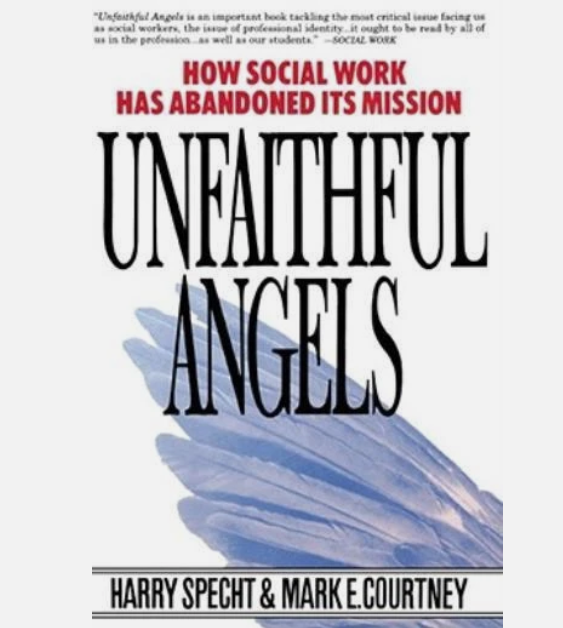
More than three decades ago, Harry Specht and Mark E. Courtney published Unfaithful Angels: How Social Work Has Abandoned Its Mission. Their central argument was deliberately provocative: social work was drifting away from its historic responsibility to poor and vulnerable communities and increasingly embracing psychotherapy, private practice, and individualized solutions to problems that are often fundamentally social and economic. The book was published in 1994. Its warning feels even more relevant today.
That is why I am launching The Social Work Reformer.
This website begins with a simple proposition: the social work profession is far too off course, and it is time for a serious conversation about returning to our intended purpose.
Specht and Courtney argued that social work’s increasing identification with psychotherapy risked separating the profession from the communities and institutions it was created to serve. The publisher’s description of Unfaithful Angels summarizes their concern plainly: social workers were increasingly moving from social services toward private practice and toward people who could afford psychotherapy.
This was not an argument that mental health does not matter. Of course it matters. Nor is it an argument that social workers should never provide therapy.
The question is one of professional identity, priorities, and mission. Social work should first and foremost concern itself with whether people have the basic conditions necessary to live decent lives.
- Are people fed?
- Are they safely housed?
- Can they obtain quality health care?
- Can their children receive a good education?
- Can people find meaningful employment and earn enough to support themselves and their families?
- Are communities safe?
- Can people access public institutions that actually function?
These are social work questions. And yet, too frequently, our response to social suffering has become individualized. Poverty becomes anxiety. Housing instability becomes depression. Community violence becomes trauma. Economic insecurity becomes stress. Therapy may help someone cope with those realities. It cannot substitute for changing them.
That distinction is at the heart of Unfaithful Angels. Social problems require social solutions. There is something deeply troubling about a profession called social work becoming increasingly preoccupied with individual treatment while the social conditions surrounding individuals deteriorate.
- A person cannot be counseled out of homelessness.
- A child cannot receive therapy as a substitute for a functioning school.
- A family cannot process its way out of food insecurity.
- A neighborhood suffering from decades of disinvestment cannot be treated with an individual diagnosis.
- And communities experiencing violence need more than services delivered after somebody has already been harmed.
The profession must reclaim its responsibility for the environments in which people live. That means housing. Education. Economic opportunity. Public health. Community safety. Youth development. Reentry. Family stability. Strong public institutions. Community organizations. Advocacy. Policy reform.
The Social Work Reformer is not being created because social work is unimportant. It is being created because social work is too important to surrender its mission without debate. There are extraordinary social workers doing difficult work every day. Clinical practice has an important place within that profession. But no profession should become so attached to one model of practice that questioning its direction becomes unacceptable.
Unfaithful Angels was controversial precisely because it challenged the profession to examine what it was becoming. Three decades later, many questions raised in the text deserve to be asked again.
That is the purpose of The Social Work Reformer.
This will be a place to examine social work education, accreditation, professional organizations, licensing, research, public policy, clinical practice, community work, and the institutions that determine what our profession values. Sometimes those conversations will be uncomfortable. They should be.
Reform does not begin by pretending everything is fine. It begins by asking what a profession exists to accomplish, and then having the courage to determine whether its institutions still serve that purpose. For social work, I believe that purpose remains remarkably straightforward.
Help build a society in which people are fed, housed, educated, healthy, safe, and afforded a meaningful opportunity to build a good life.
Dr. Maurice Vann
The Social Work Reformer
For readers interested in the book that inspired this inaugural post, Unfaithful Angels: How Social Work Has Abandoned Its Mission by Harry Specht and Mark E. Courtney is described by its publisher here: Unfaithful Angels, Simon & Schuster
One response to “Launching The Social Work Reformer”
Hi, this is a comment.
To get started with moderating, editing, and deleting comments, please visit the Comments screen in the dashboard.
Commenter avatars come from Gravatar.